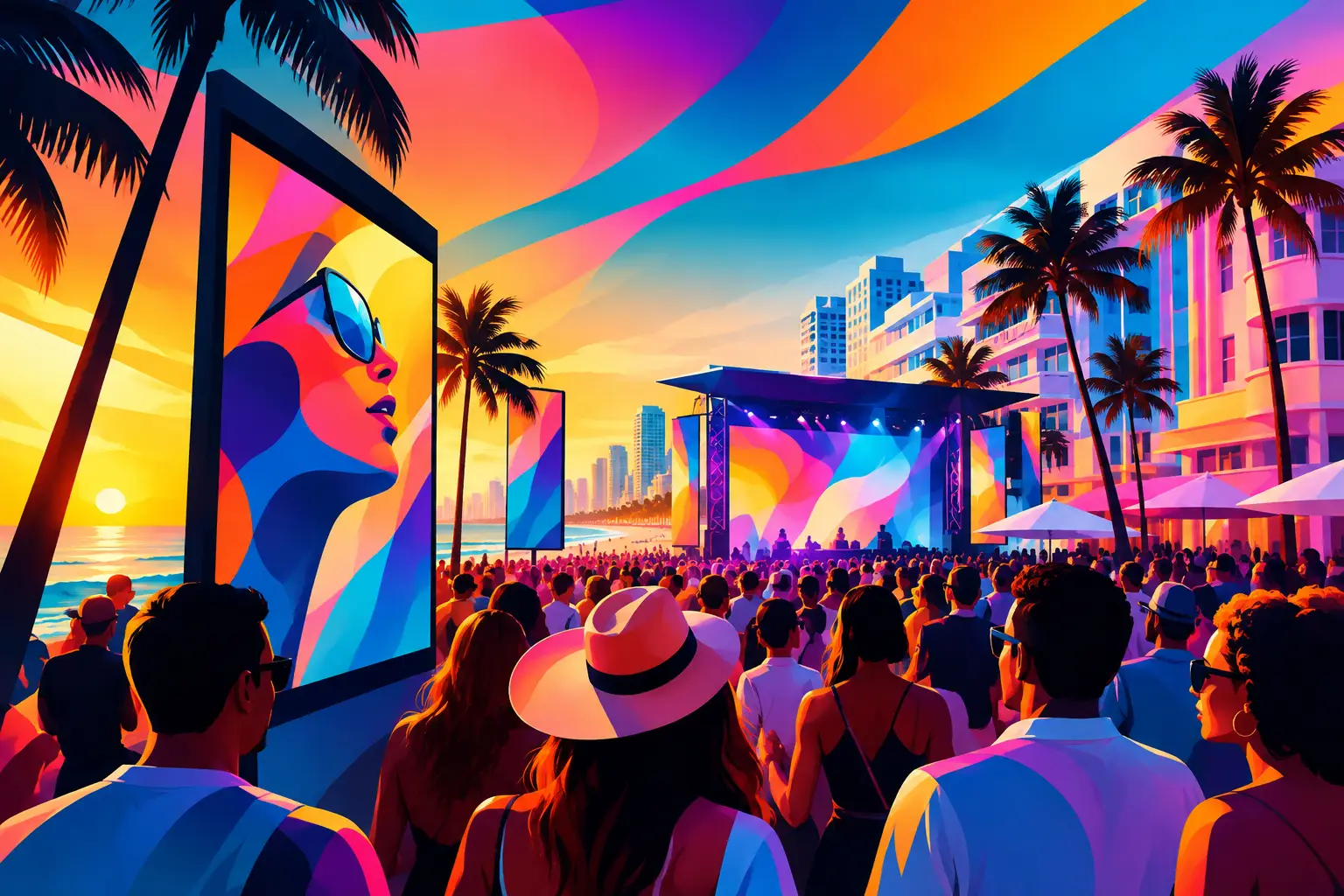
A packed Ocean Drive sidewalk, a hotel check-in line before sunset, and a convention crowd spilling onto Collins Avenue are not the same audience. South Beach event advertising works when it treats those moments differently - with the right message, route, screen format, and timing for the people already moving through the district.
For an event producer, hospitality operator, restaurant group, or brand team, the goal is not vague awareness. It is getting a launch, party, promotion, pop-up, or ticketed experience into the conversation before people choose where to go next. In South Beach, that decision can happen within a few blocks and a few minutes.
Why South Beach Requires Precision
South Beach is compact, visual, and constantly in motion. It has beach traffic in the daytime, hotel and retail activity in the afternoon, dinner reservations and nightlife at night, plus convention, festival, and private-event surges that change the map by the hour. A campaign aimed at everyone will usually feel like it is speaking to no one.
The strongest event campaigns start with a practical question: where is the decision being made? A day party may need visibility around hotel corridors, beach access points, and restaurant rows from late morning through afternoon. A club event needs a different play around dinner, valet lines, rideshare pickup zones, and nightlife corridors. A trade-show activation may need to intercept attendees near the Miami Beach Convention Center, nearby hotels, and the routes connecting them.
That is why mobile LED advertising has a real advantage here. Rather than paying for a fixed placement that reaches the same location all day, an event advertiser can move the message with the crowd. Circulate near lunch traffic, reposition for convention release times, then work the evening flow when dinner becomes nightlife.
Build a South Beach Event Advertising Route Around Intent
A route should be built around the audience, not just famous streets. Ocean Drive has obvious value, but it is not automatically the answer for every event. Sometimes the higher-value impression comes closer to a host hotel, a competing venue, a sponsor activation, or a rideshare-heavy corridor where guests are actively deciding their next stop.
Start with the event's conversion point. If the goal is ticket sales, the campaign needs a clear date, time, location, and simple call to action. If the goal is walk-ins tonight, lead with urgency: what is happening, how close it is, and why people should choose it now. If the goal is a brand launch or sponsor visibility, the creative can give more room to product visuals, video, social handles, and a memorable campaign line.
Then choose dayparts that match behavior. Morning can be valuable for fitness, wellness, brunch, and conference audiences. Midday can capture beachgoers, tourists, and lunch crowds. Early evening is prime for restaurants, hotel programming, retail, and ticketed experiences. Late-night routes are built for clubs, DJs, beverage brands, and after-hours activations.
A three-hour block can be enough for a focused push if the offer is timely and the route is tight. A multi-day schedule makes more sense for a conference, festival, grand opening, or event with a long purchase window. The trade-off is simple: concentrated hours create urgency; broader scheduling builds frequency. The best choice depends on how quickly the audience needs to act.
Put the Message Where the Crowd Can Read It
South Beach is not a place for overstuffed artwork. People may be walking, riding, waiting for a car, or looking out from a restaurant patio. Your event ad needs to communicate at a glance.
Use one dominant visual, a short headline, and high-contrast type. Put the event name or offer first. Follow with the essential detail: tonight, this weekend, free entry before a set time, RSVP required, one block away, or live at a specific venue. QR codes can work when the truck is parked or dwelling near a crowd, but they should not carry the entire campaign. A person should understand the offer without scanning anything.
Motion graphics and video can add energy, especially for fashion, music, nightlife, sports, and product launches. But fast animation is not automatically better. If the key message appears for half a second, the screen is working harder than the audience. Build loops that repeat the event name, offer, and location often enough for real-world viewing.
For multilingual outreach, create versions that match the audience and location. English may be the primary creative, while Spanish or Portuguese variations can make a campaign more relevant for specific visitor and local segments. Do not simply shrink three languages onto one panel. Run distinct creative rotations so every message stays clean and readable.
Use Electric LED Trucks Where Diesel Cannot Go
Many event environments want the visual impact of a mobile billboard but do not want generator noise, exhaust, or the operational friction of a conventional truck. That matters around hotel motor courts, residential streets, private venues, convention environments, and noise-sensitive properties.
Miami Adz 305 operates a silent, 100% battery-electric LED billboard truck with large-format, high-brightness 4K panels. That gives event marketers more practical access to premium zones where a diesel-powered platform may be a poor fit or unwelcome. The benefit is not just environmental positioning. It is the ability to show up closer to the audience without turning the campaign itself into a disruption.
For a private event, this can mean displaying sponsor content at arrival or using a live feed during a branded moment. For a hotel activation, it can mean placing event creative near guest traffic without adding engine or generator noise. For a nightlife campaign, it means the screen can deliver high-impact motion creative while the route stays flexible around real-time crowd patterns.
Match the Campaign to the Event Type
A grand opening needs repetition around the immediate neighborhood, especially during the days leading to opening night and the first weekend. A restaurant or lounge can pair a mobile campaign with a limited-time offer that gives people a reason to enter now rather than save the venue for later.
A real estate event needs another approach. For a broker open, luxury listing launch, or development preview, the screen can carry property video, agent branding, event details, and directional messaging near high-income hotel, dining, and retail corridors. The route should favor the audience profile, not just the listing address.
Conference and trade-show advertisers should think beyond the convention floor. Attendees have downtime at breakfast, lunch, happy hour, and after sessions. An offsite sponsor event can build visibility along hotel corridors and nearby gathering points, while a product launch can rotate video creative that makes the brand recognizable before attendees encounter it in person.
For stadium-adjacent or major entertainment activations, timing becomes even more valuable. Work the pre-event rush when people are arriving, then position near post-event traffic when groups are deciding where to eat, celebrate, or continue the night. The message may need to change between those windows.
Demand Proof After the Route Ends
Event advertising moves fast, but the reporting should not be vague. A campaign should leave behind more than a claim that the truck drove around South Beach. Ask for GPS route data, dwell-time documentation, photos, campaign timing, and traffic-modeled impression reporting.
These details help a marketing team understand what actually ran, where the screen spent time, and how the planned route translated into delivery. They also make it easier to improve the next campaign. If a late-night corridor produced stronger engagement than an afternoon hotel route, that insight can shape the next event push.
Measurement has limits. An impression model is not the same as a ticket sale, and a photo does not prove every person saw the screen. Still, accountable route reporting is far more useful than treating mobile media as a black box. Pair it with trackable promo codes, event-specific landing pages, QR scans, RSVP spikes, or point-of-sale redemptions to see whether attention turned into action.
Plan Early, Then Stay Flexible
South Beach events compete with weather, traffic, road closures, competing activations, and a calendar that can shift quickly. Provide the event date, venue, target audience, campaign goal, preferred neighborhoods, and creative assets as early as possible. That gives the route and screen content room to be planned properly.
Keep the final message flexible. If tickets are moving slowly, switch the creative to urgency. If an event sells out, pivot to waitlist messaging, a sponsor message, or the next date. If a storm changes pedestrian flow, move toward hotel, restaurant, and indoor-venue corridors rather than forcing a route that no longer matches behavior.
The most effective South Beach event campaign feels like it arrived exactly where the crowd was already headed. Build it around that next decision, make the screen impossible to misunderstand, and let the route earn attention block by block.