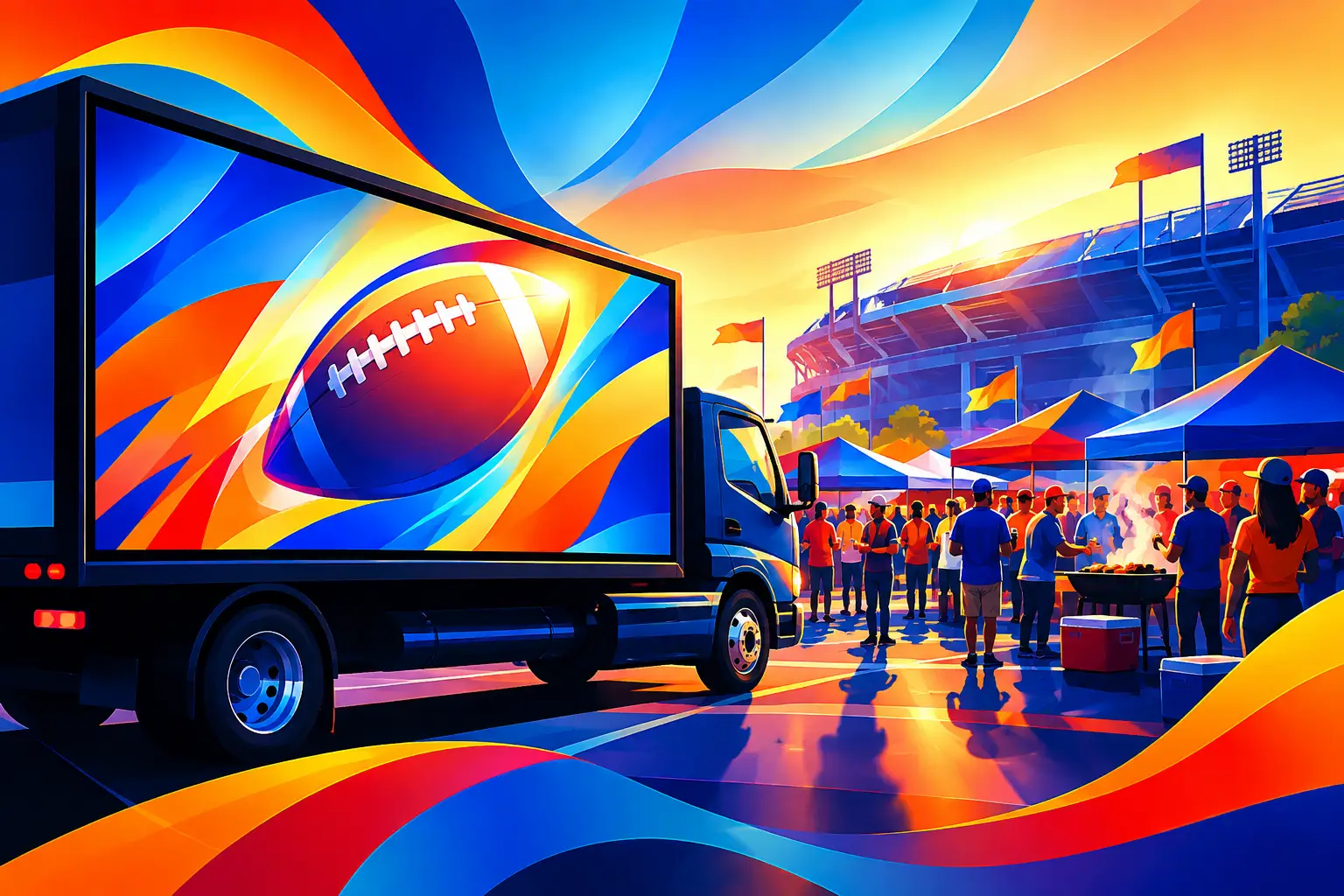
A stadium tailgate advertising truck puts your message in front of people before they disappear into the gates. Fans arrive early, walk slowly, stand in lines, meet friends, buy food, and take photos. That is a rare window for a local brand: a concentrated crowd, a charged-up atmosphere, and enough dwell time for a sharp offer to land.
For South Florida advertisers, the play is not simply driving near a venue. The value comes from owning the approach roads, parking zones, hospitality entrances, fan meetups, and post-game traffic where people are deciding where to eat, shop, book, or go next. A high-brightness LED truck gives you a premium visual presence without committing to a permanent billboard months in advance.
Why Stadium Tailgates Create Real Attention
Tailgates are built around anticipation. A fan checking a phone outside Hard Rock Stadium, loanDepot park, Kaseya Center, or a college venue is not in the same mindset as someone scrolling at home. They are already out, with friends, spending money, and looking for the next move.
That makes stadium activations especially useful for restaurants, bars, nightlife concepts, retail launches, car dealers, sports-adjacent brands, real estate teams, hotels, and event producers. A game-day promotion can point fans to a nearby watch party. A hotel can own the arrival corridor during a major event weekend. A broker can put a listing or development directly in front of a targeted local audience.
The format also works because it cannot be skipped. A large LED screen moving through the fan zone is part of the physical environment. Motion graphics, full video, live social content, and a clean call to action do more than deliver an impression. They give people something to notice, talk about, and photograph.
What a Stadium Tailgate Advertising Truck Should Do
A stadium campaign should have a job. “Build awareness” is too broad on its own. A better brief names the action you want from fans over a specific game-day window: visit a nearby location, scan for an offer, remember an opening date, follow an event account, or choose your venue after the final whistle.
Start with the crowd. Are you reaching season-ticket holders arriving early, visiting fans in rideshare drop-off areas, corporate guests at premium entrances, or people leaving toward Brickell, Wynwood, Las Olas, or West Palm Beach? Each audience moves differently, and the truck route should reflect that.
Then match the screen message to the moment. Pre-game creative can push urgency: “Show this screen tonight for 15% off.” During tailgating, use bold brand-building video with a simple location cue. Post-game creative should make the next destination obvious, especially when fans are deciding whether to head home or keep the night going.
A strong campaign usually answers three questions in seconds: who is behind the message, what is the offer or event, and where should people go next. If the answer requires a paragraph of copy, the creative is doing too much.
Build for the distance, not the desktop
A digital ad that looks great on a laptop can fail from 50 feet away. Stadium-area creative needs oversized type, strong contrast, minimal copy, and a visual hierarchy that works while someone is walking past, sitting in traffic, or looking through a car window.
Use one main headline, one visual idea, and one call to action. QR codes can work when the truck is parked in a controlled fan area with real dwell time. They are less useful on a fast-moving corridor. In that setting, an easy-to-remember offer, short URL, branded hashtag, or location name often performs better.
For multilingual South Florida audiences, language selection is a routing decision as much as a creative decision. English, Spanish, and Portuguese messages can rotate by daypart, neighborhood, or event audience. Do not cram three languages into one frame unless the message stays exceptionally simple.
Route Planning Is the Difference Between Presence and Performance
A truck parked outside a stadium at kickoff may look impressive, but it can miss the best audience window. Fans are inside. The smarter plan captures arrivals before the gates, holds in approved high-dwell locations during the tailgate period, then reappears where crowds exit after the event.
That can mean targeting parking approach routes, pedestrian corridors, restaurants near the venue, rideshare queues, transit-adjacent blocks, and entertainment districts. The ideal route depends on the venue, the event, local traffic controls, private-property access, and the behavior of that crowd.
Plan for congestion instead of treating it as a problem. On game day, slow-moving traffic can create extended screen exposure when the vehicle is positioned legally and safely. But gridlock can also break a route if you have not allowed time for staging, detours, and venue security instructions. A professional operator builds contingencies into the schedule.
Miami Adz 305 uses audience-first routes across Miami-Dade, Broward, and Palm Beach, with campaign blocks beginning at three hours. That matters for tailgates because the plan can be concentrated around the highest-value arrival and departure windows rather than stretched across an unfocused day.
Venue access changes the plan
Not every stadium or tailgate zone permits the same vehicles, parking positions, noise levels, or display behavior. Private lots, hospitality zones, convention-style event spaces, and residential-adjacent areas may have their own restrictions. Secure approvals before creative goes live, and never build a campaign around an assumed parking location.
An all-electric, generator-free LED truck has a practical advantage here. Silent operation can be more acceptable at hotels, private events, controlled parking areas, and noise-sensitive locations than a diesel truck running a generator. It does not eliminate venue rules, but it gives planners more workable options.
Make the Screen Earn Its Premium Format
A premium LED screen deserves premium content. This does not mean overproduced video for its own sake. It means footage, typography, color, and pacing designed for a big outdoor display.
For a restaurant or nightlife activation, show the experience: a packed patio, signature dish, DJ, or bottle presentation. For real estate, lead with the property, neighborhood, price point if it is a selling advantage, and a direct contact path. For an event launch, show the date, venue, artist or headline attraction, and ticket urgency.
Motion should support readability. Fast cuts and tiny legal copy may look busy, but they waste the most valuable seconds of exposure. A seven-to-ten-second loop with a clear hero frame usually outperforms a video that tries to tell an entire story.
Consider the daylight reality, too. South Florida sun is unforgiving. High-brightness 4K LED panels keep creative visible in harsh daylight, but your artwork still needs contrast and disciplined color choices. Pale type over a busy beach image is not a game-day strategy.
Measure More Than a Crowd Estimate
A stadium event can produce big audience numbers, but attendance alone is not campaign proof. Your reporting should show where the vehicle traveled, how long it dwelled in planned areas, what creative ran, and when the campaign was active.
GPS route logs, dwell-time records, timestamped photos, and traffic-modeled impressions create a credible post-campaign record. Pair that operational proof with your own response signals: QR scans, promo code redemptions, direct traffic, reservation volume, ticket sales, store visits, or a lift in branded searches.
Be realistic about attribution. A fan may see the truck, mention it to a friend, and visit two days later without scanning anything. Not every response can be tied to a single screen exposure. Still, a unique offer code, event-specific landing path, or campaign-only phone extension can make the results much clearer.
A Better Game-Day Campaign Brief
Before booking, define the event date, venue, audience, offer, target geography, and desired fan action. Decide whether you need a parked display, a circulation route, or both. Share any sponsor requirements, venue relationships, brand restrictions, and creative deadlines early, because stadium inventory and access conditions can move quickly.
The best campaigns do not try to speak to every person attending the game. They choose a valuable segment and meet it at the moment a decision is being made. A late-night restaurant does not need to own the whole stadium. It needs to be visible to the right crowd on the right exit route when the game ends.
Game day already has the energy. Put your message where that energy is moving, give fans one clear next step, and make every mile of the route accountable.