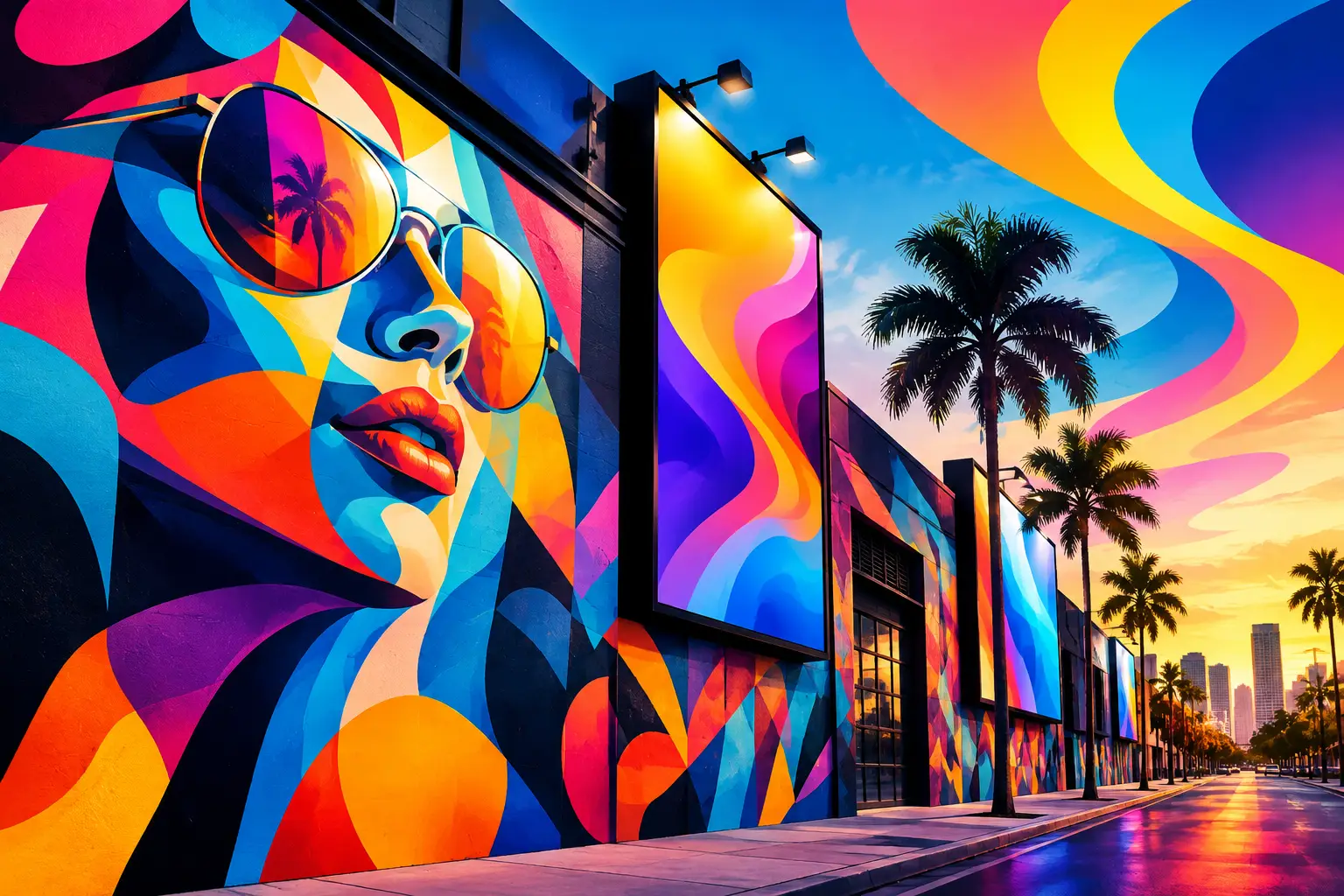
Wynwood advertising opportunities are not about buying a distant sign and hoping the right crowd notices it. This is a neighborhood where people move block to block, stop for murals, line up for coffee, meet for dinner, and make plans in real time. Brands that win here show up with the right message in the right corridor at the right hour.
For a local business, property team, event producer, or consumer brand, that calls for media with geographic control. A premium mobile LED billboard can circulate around Wynwood Walls before a weekend crowd builds, cover Northwest 2nd Avenue during lunch, then move toward the Design District, Midtown, or Brickell as the audience changes. The screen is visible. The route is intentional. The campaign does not have to wait months for a permanent placement.
Why Wynwood Demands a Different Ad Plan
Wynwood is dense with visual competition. Storefronts, public art, streetwear drops, galleries, food concepts, fitness studios, apartment leasing teams, and nightlife venues all compete for attention. A generic campaign can disappear fast. The better move is to treat the district like an active marketplace, not a pin on a media map.
That means aligning the route with the reason people are in the area. A restaurant can run an offer near peak dining windows. A developer can place a new rental or condo message around the paths used by prospective residents and brokers. A festival can build awareness before gates open, then redirect people toward parking, entrances, or sponsor activations.
The trade-off is that hyperlocal media requires planning. You need a clean audience definition, a message that can be understood in seconds, and a route that reflects actual traffic patterns rather than a vague idea of "Wynwood exposure." In return, you get much more control over where your budget works.
Mobile LED Billboard Opportunities in Wynwood
A high-brightness 4K LED truck gives advertisers a format built for movement and immediacy. Unlike a static board that remains in one location, a mobile unit can make repeated passes through priority blocks, position near a venue, and shift with the daypart. Static artwork works well for a clear offer or brand statement. Motion graphics and video are useful when the creative needs to demonstrate a product, build anticipation, or create a premium event feel.
The most effective Wynwood campaigns usually fall into a few practical categories.
Grand Openings and Limited-Time Offers
Opening a new restaurant, retail concept, salon, medical practice, or fitness studio? The first few days matter because the neighborhood is built around discovery. Run a concise message that states what is opening, where it is, and why people should go now. A launch offer can work, but only if the call to action stays readable from a moving street environment.
For example, a new fast-casual concept might use lunch routes from 11 a.m. to 2 p.m., then return between 5 p.m. and 8 p.m. with a dinner-focused message. That is more useful than spending the same budget reaching an all-day audience that is not ready to act.
Events, Pop-Ups, and Brand Activations
Wynwood is a natural stage for pop-ups, gallery nights, music events, fashion launches, and branded experiences. Mobile LED advertising can work before the event as a moving invitation and during the event as a directional tool. The screen can display countdowns, event details, sponsor creative, live social content, or a feed from the activation itself.
Venue access matters here. A silent, battery-electric LED truck can operate around hotel motor courts, event spaces, and noise-sensitive areas where generator-powered trucks may be a poor fit or may not be permitted. That is not a cosmetic detail. It expands where the campaign can physically go and how close it can get to the audience.
Real Estate and Property Marketing
Wynwood and the surrounding urban core attract renters, investors, buyers, and commercial tenants who are already touring neighborhoods. A property campaign can reach them while they are seeing the area firsthand. For residential leasing, the message might spotlight move-in availability, amenities, or a leasing event. For commercial space, it can reach operators scouting new locations.
The creative should not try to sell the entire property in one screen. Lead with the strongest visual or value proposition, then make the next step simple: tour today, visit the leasing office, or scan a QR code only if the landing experience is mobile-ready. On-screen copy needs to work even when someone has just three seconds at a stoplight.
Hospitality, Nightlife, and Weekend Traffic
Friday night in Wynwood is different from Tuesday morning. Hospitality operators should plan around the moments when people are choosing where to eat, drink, stay, or continue the night. A hotel can target visitors moving between Wynwood, the Design District, downtown, and Miami Beach. A club or lounge can promote a themed night near dinner corridors before the late-night rush.
Multilingual creative can strengthen these campaigns. English, Spanish, and Portuguese messaging should be designed for the audience and location, not simply translated word for word. A short, culturally clear message will outperform a crowded screen trying to speak to everyone at once.
Build the Route Around Real Decisions
The route is the media buy. Before a campaign launches, define the audience, the desired action, the date range, and the time windows that matter. Then connect those goals to streets, venues, event calendars, and nearby districts.
A three-hour campaign may be enough for a targeted grand opening push or a pre-event burst. A multi-day schedule makes more sense for a leasing launch, recurring promotion, or a brand that wants frequency across several neighborhood moments. There is no universal best duration. It depends on whether the goal is immediate turnout, awareness, repeat exposure, or a combination of all three.
Wynwood also works best as part of a corridor strategy. If a brand only circles the same few blocks, it may reach people already committed to the neighborhood but miss the inbound audience. Connecting Wynwood with Midtown, the Design District, Edgewater, Brickell, downtown, or stadium and arena routes can create useful frequency without wasting hours.
Creative That Holds Up on the Street
Street-level LED creative has one job: communicate before the vehicle has passed. Keep the headline large, the contrast strong, and the message focused. Small legal copy, dense menus, and too many logos are not campaign strategy. They are lost opportunity.
Use motion with discipline. A subtle animated background, product reveal, or event countdown can attract attention. Fast cuts and overloaded video can make the message harder to read, especially in traffic. The strongest ads often pair one hero visual with one direct statement and one action.
For a retail launch, that might be: “NOW OPEN IN WYNWOOD.” For an event: “SATURDAY 8 PM. WYNWOOD.” For a listing: “TOUR NEW WYNWOOD RESIDENCES TODAY.” The full details can live on a QR code, short URL, social handle, or onsite team. The LED screen earns attention first.
Measure More Than a Vague Impression Count
Good outdoor advertising should leave proof behind. A campaign report can include GPS route records, dwell time, photos, traffic-modeled impressions, and traffic-mode breakdowns. Those details let a marketing team verify that the vehicle covered the agreed priority areas and spent meaningful time where the audience was expected.
Measurement does have limits. A traffic-modeled impression is not the same as a purchase, lead, or ticket sale. To connect the campaign to business results, pair the route report with offer codes, QR scans, landing-page traffic, reservation data, in-store mentions, or event registrations. The best reporting combines delivery proof with the response metric that matters to your business.
Miami Adz 305 plans all-electric mobile LED routes with this level of accountability, from creative formatting through post-campaign route and dwell-time reporting. That matters when a launch window is short and every hour needs to earn its place on the schedule.
Make the Next Campaign Easy to Act On
Start with one decision: where do you need people to notice you and what should they do next? From there, choose the date, daypart, route corridor, and creative format. A restaurant might prioritize lunch and dinner movement. A brand activation may need a venue-adjacent position at a specific hour. A real estate team may want weekend tours and broker-heavy routes.
Wynwood rewards advertisers who show up with purpose. Put a clear message on a premium screen, run it where your buyers are already moving, and make the route work as hard as the creative. When the next opening, event, or offer needs local attention fast, plan the streets before you plan the spend.